
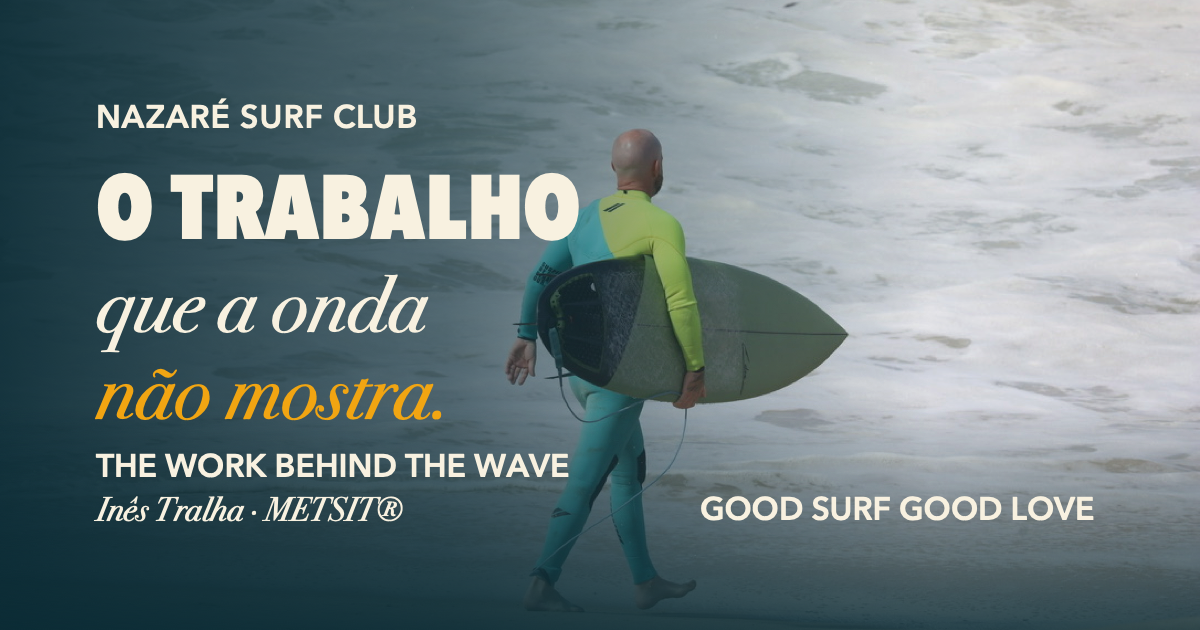
Thank you to Nazaré Surf Club for inviting me to be part of this project and for the trust placed in my work.
I have been working with Eddie and the team, bringing the principles that guide my practice: understanding the person, observing their surfing and identifying what makes sense to work on next.
Anyone who entrusts me with a few hours of their day is investing time, money and trust. I feel an enormous responsibility to give my best, adapted to the person in front of me. That responsibility begins with preparing the session and continues after we leave the water.
In my work, assessment gives direction to training. I seek to understand the surfer’s athletic level through their motor control and the breadth of their sporting experience: how they control their body, which movements they have mastered and what resources they can bring to surfing from different sporting activities.
I want to understand how they paddle, how they read the ocean, where they position themselves, how they relate to their board and what decisions they can make in the conditions they are surfing in.
I want fun and adrenaline to be part of what we are working towards, with preparation to match. Assessment helps me manage risk and adapt the equipment, conditions and challenges to each surfer, seeking the best possible conditions for them to enjoy the experience.
Think about catching a wave. Paddling, positioning and the timing of the take-off need to be observed together. Asking for more power or speed, without understanding what is happening, can leave the difficulty we want to work on unexplained.
That is why I structure observation through three elements of the METSIT® method: the surfer, the board and the ocean.
The surfer brings a body, a sporting history, expectations and their own way of learning. The board needs to make sense for that person and for the work we are proposing. The ocean provides the specific conditions in which all of this will happen.
Practical decisions emerge from this relationship: what equipment to choose, what skills to observe, what priority to set and how to organise the following sessions. This is the structure I bring to my contribution to the project.
At Nazaré Surf Club, surf coaching brings together assessment, technical guidance, video and feedback. My contribution lies in this area, within a project that brings together different professionals.
Working as a team requires clarity. Each intervention needs a purpose, and each professional needs to know what their contribution is. This idea also runs through what I have written about planning surf training: decisions make sense when they are part of a journey.
It is in this coordination, and in individualisation, that I still find one of the biggest gaps in training and preparation across the surfing world. When several people contribute, their decisions need to connect and make sense for that surfer.
For anyone learning or training, I suggest four questions to ask their coach at the next session:
- What am I working on?
- Why was this priority chosen for me?
- What will we observe to decide the next step?
- How does this work connect with the rest of my preparation?
I want the surfer to understand the work they are involved in. To be able to relate what they feel to what we observe. To leave the session with a useful indication of how to continue.
The body is not a detail. It is the system in which talent happens.
It is with this conviction that I am working with Eddie and the Nazaré Surf Club team.
If the adventure and adrenaline of big waves appeal to you, contact Nazaré Surf Club to learn about the programme and explore how to prepare for your journey.
Book a first assessment session with me. You will have a serious, professional approach grounded in multidisciplinary academic knowledge, so that we can define the best starting point for your surfing.
Inês Tralha
Good Surf Good Love